
Construction Equipment Synthetic Oil: What Fleet Managers Actually Need to Know
Let’s start with a number that doesn’t show up on the repair invoice.
A compact excavator goes down mid-project. It’s not a total loss — a hydraulic pump, maybe three to five days to source the part and get the machine back in service. The repair invoice comes to around $2,800.
But that’s not what it actually costs.
The crew on that project doesn’t stop. You’re either renting a replacement — typically $1,200 to $1,500 a day for a comparable machine — or you’re pulling equipment off another site and shuffling the schedule. Either way, you’re four to five days behind on a job where the GC has a timeline, the owner has a move-in date, and your margin just got a lot thinner.
Construction contractors don’t lose repair-invoice money when a machine breaks down. They lose days. And in this business, days have a price attached to them.
The conversation I have with construction fleet operators isn’t ‘spend more on better oil.’ It’s ‘here’s what’s actually driving your maintenance cost, and here’s how to get it under control.’
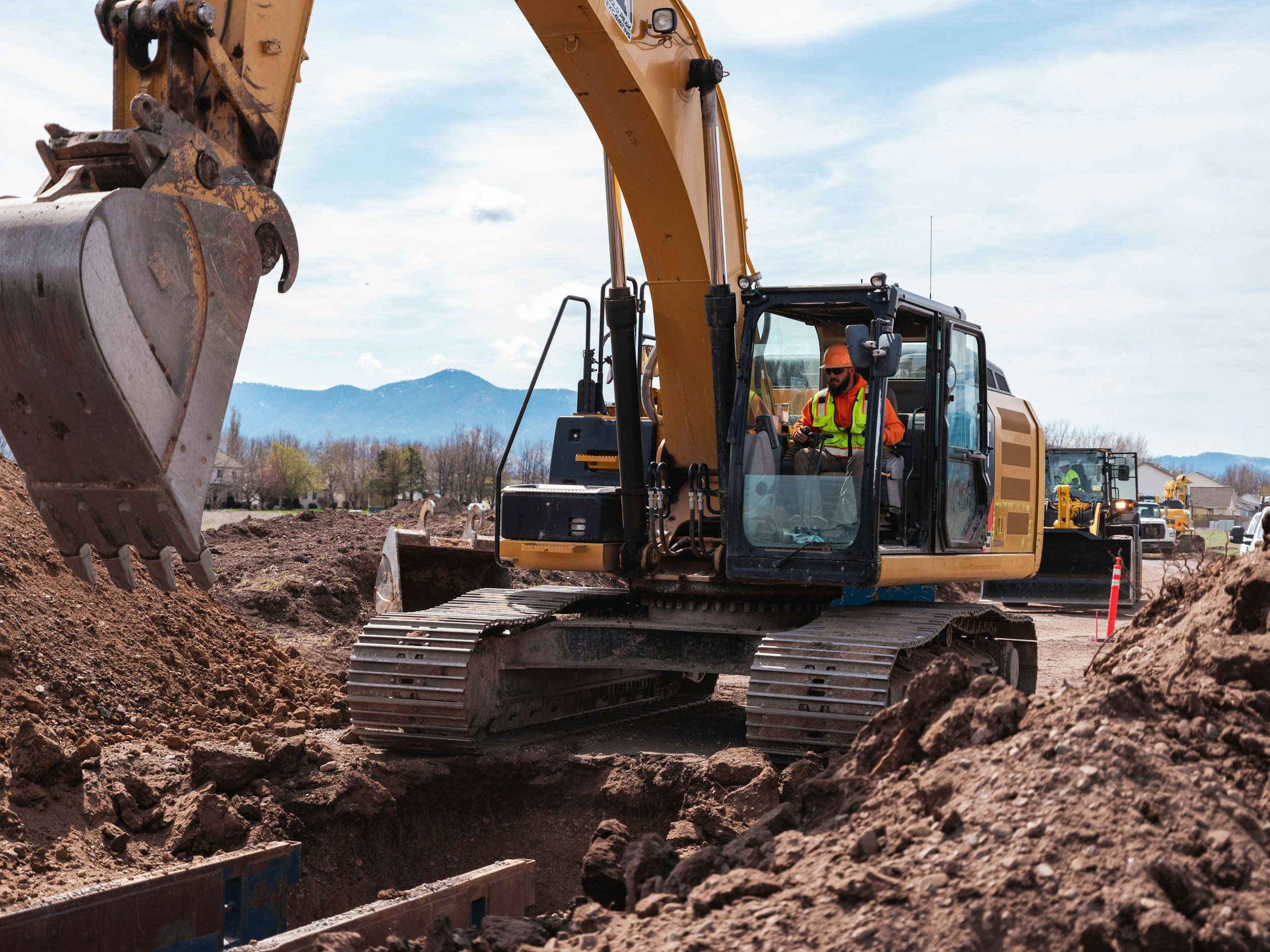
Heavy excavator operating under full load on active commercial job site
Why Construction Equipment Is Hard on Oil
Commercial construction equipment runs under conditions that the oil ratings on most auto parts store shelves were never designed for. The gap between a passenger vehicle and a commercial fleet truck or excavator is wider than most people realize.
Diesel combustion and soot
Every time a diesel engine fires, combustion byproducts — including soot — work their way past the rings and into the oil. Quality diesel oil keeps that soot in suspension so the filter can catch it. Low-quality or degraded oil lets it agglomerate on engine surfaces as sludge and cause abrasive wear on bearings, rings, liners, cam/lifters and the turbo. In high-hour commercial equipment, that distinction shows up directly in engine longevity.
Sustained high-load operation
A pickup truck driving on the highway runs at maybe 30% of its rated power output. An excavator digging or a loader pushing material runs at 70–90% for hours at a stretch. That sustained load generates heat that breaks down oil at a rate that light-duty ratings don’t account for.
Environmental contamination
Active construction sites are hard on everything. Airborne dust, silica, moisture — it finds its way into the oil. Quality oil manages it; degraded oil lets it accumulate and starts contributing to wear.
Temperature extremes
Georgia's heat compounds the thermal stress on engine oil and hydraulic fluid. Cold morning starts create wear during the startup phase when oil hasn’t yet been distributed through the system. Both ends of the temperature range matter.
This is why what meets spec on paper for a passenger diesel and what actually holds up in a commercial excavator running all day in a Georgia summer are not the same thing.
What Synthetic Oil Changes for Heavy Equipment
Synthetic oil doesn’t change the work the machine is doing. What it changes is how long the oil can keep protecting the machine while it does that work.
Thermal stability. Synthetic base oils are molecularly uniform in a way that refined mineral oil isn’t. They resist breakdown under sustained high heat significantly longer, which matters directly for equipment running under load most of the day.
Soot suspension
High-quality synthetic diesel oil — specifically formulated for commercial use, not just passenger diesels — maintains its soot dispersancy over longer service intervals. The oil keeps working rather than becoming part of the problem.
Extended drain intervals
This is where the financial case lives. Fewer oil changes mean fewer service events, less labor, and less equipment pulled from rotation. I’ll put specific numbers on this below.
Cold-start protection
Synthetic oil flows to critical engine surfaces faster in cold temperatures. On early morning job starts — which is most job starts in construction — that’s the moment of highest wear in the entire operating cycle. Synthetic minimizes it.
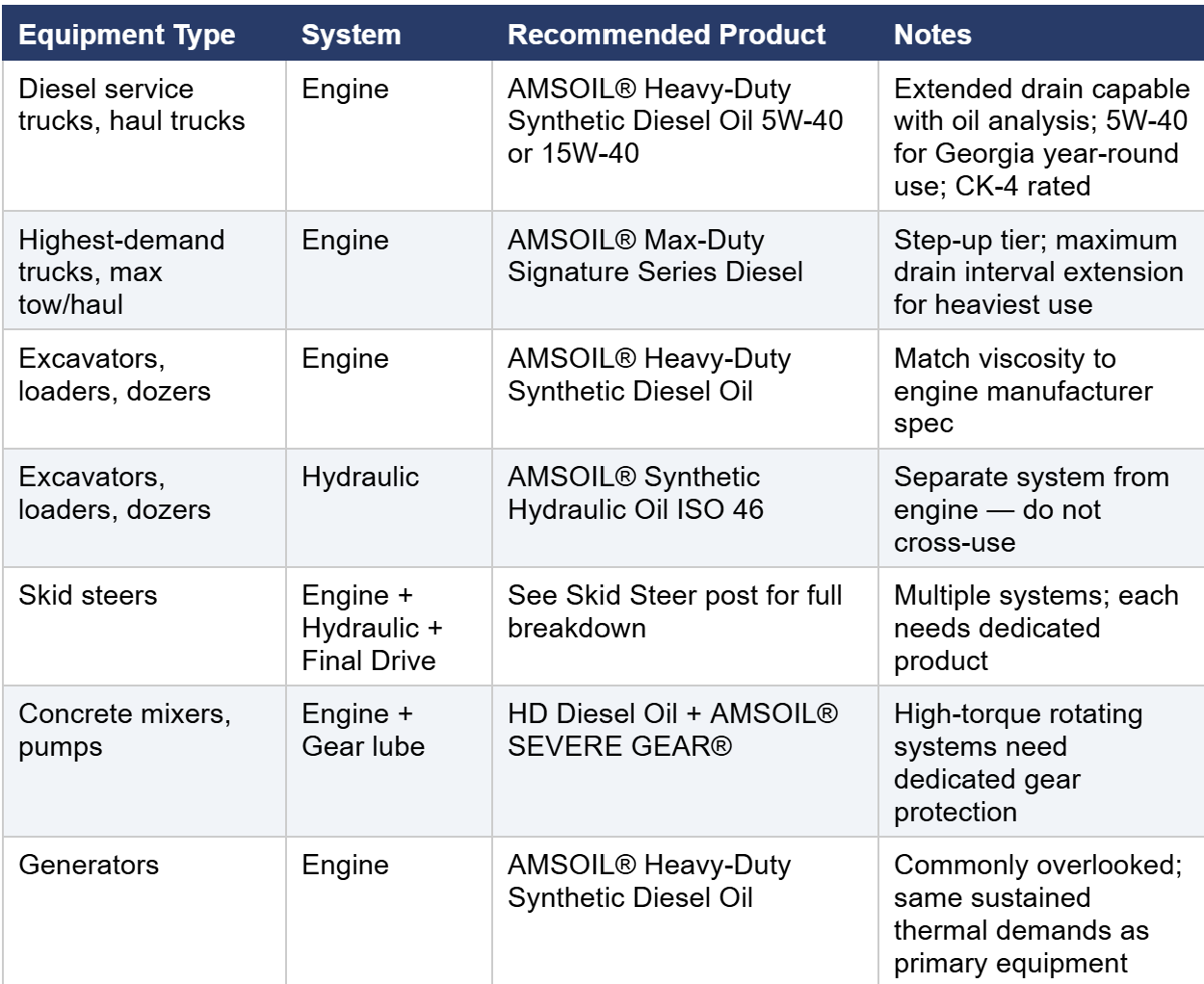
Construction Equipment Applications: What Goes Where
Organized by equipment type, because that’s how fleet managers actually think about their machines — not by product line.
Product Links
AMSOIL® Heavy-Duty Synthetic Diesel Oil 5W-40 → https://www.amsoil.com/p/heavy-duty-synthetic-diesel-oil/?zo=515216
AMSOIL® Max-Duty Signature Series Diesel → https://www.amsoil.com/p/max-duty-signature-series-diesel/?zo=515216
AMSOIL® Synthetic Hydraulic Oil ISO 46 → https://www.amsoil.com/p/synthetic-hydraulic-oil/?zo=515216
AMSOIL® SEVERE GEAR® Synthetic Gear Lube → https://www.amsoil.com/p/severe-gear-synthetic-gear-lube/?zo=515216
A Note on API Ratings: What CK-4 and FA-4 Actually Mean
Most fleet managers choose diesel oil based on viscosity and brand. That works until it doesn’t—usually when a newer truck with emissions equipment gets the wrong-spec oil.
CK-4 is the current API rating for heavy-duty diesel engines using conventional viscosities (5W-40, 15W-40). It covers soot management, oxidation control, and shear stability — the core requirements for heavy-duty diesel service. Most commercial construction equipment specifies CK-4. AMSOIL® Heavy-Duty Diesel Oil carries CK-4 certification.
FA-4 is for newer engines designed to use lower-viscosity oils (10W30, 5W-30) to optimize fuel economy. If you’re running newer on-highway trucks alongside traditional construction equipment, your fleet may spec both. They are not interchangeable — confirm your engine’s requirement before selecting.
If you’re not sure what your specific equipment requires, your service manual will confirm it — or I can.
The Extended Drain Interval ROI: A Real Fleet Scenario
Let me put a specific scenario on this, because the numbers are more compelling than the concept.
A mid-size construction contractor running ten diesel machines — a mix of service trucks, two compact excavators, and a loader. On a conventional 5,000-mile / 250-hour oil change schedule, they’re doing roughly 40 oil changes a year across that fleet. At $80–120 in oil and filter costs per change, plus 45 minutes of labor per service, that’s real money and real downtime every time.
Switching to AMSOIL® Heavy-Duty Synthetic Diesel Oil with an oil analysis program, a realistic extended interval for fleet trucks moves to 10,000–15,000 miles. For equipment running by the hour, 500+ hours depending on the application and operating conditions.
At 10,000-mile intervals, that same fleet drops to roughly 20 oil changes a year. Half the service events. Half the labor. Less equipment pulled from rotation during the months that matter most.
I walked through this math with a contractor in North Georgia running eight machines. The number that surprised him wasn’t the cost of oil — it was the labor hours his team was spending on unnecessary service events. The oil cost delta paid for itself within the first season.
The premium cost of synthetic versus conventional on a per-change basis is real. On an annual cost basis — factoring in fewer changes and the wear reduction that reduces repair frequency — most of the fleet operators I work with come out ahead or even by the end of the first year.
Want to know more? Check out our post on the True Cost of Oil.
The Warranty and Emissions System Question
Newer commercial trucks — anything with a DPF (Diesel Particulate Filter) or SCR (Selective Catalytic Reduction) system — have specific oil compatibility requirements. Using an oil with the wrong sulfated ash content can damage aftertreatment systems and create emissions compliance issues.
AMSOIL® Heavy-Duty Diesel Oil and Max-Duty Signature Series Diesel are formulated to be compatible with DPF and SCR systems. Confirm against your specific vehicle’s spec sheet before finalizing product selection — that’s a five-minute conversation I’m happy to have.
On the warranty question: the Magnuson-Moss Warranty Act protects your right to use any oil that meets OEM specifications without voiding your warranty. AMSOIL® Warranty Secure™ covers customers using AMSOIL products according to recommended guidelines. In my experience, the warranty concern is usually the reason a fleet manager hasn’t already made this switch — and it’s the one that requires the least worry once you understand how the law actually works.
Making the Switch: What Fleet Managers Actually Need to Know
Fleet managers have legitimate operational questions about switching lubricants that go beyond which product to use.
What happens to existing oil inventory? Is there a compatibility concern with transitioning machines mid-cycle? How do you make sure whoever handles the actual maintenance is using the right product for each system?
These aren’t complicated problems, but they do require a conversation. I work through fleet transitions regularly — it usually takes one call to map a product list for every machine in the fleet, set the intervals, and get an oil analysis program started to confirm everything’s working.
That’s the value of working with a dealer rather than a product page. The product page doesn’t know you’re running a Kubota excavator alongside three Ford F-350s and a 20-year-old Cat loader. I do, once you tell me.
FAQ
Can I use heavy-duty diesel oil in a pickup truck?
Yes, if it meets the specifications your truck requires. AMSOIL® Heavy-Duty Diesel Oil is appropriate for both commercial fleet trucks and diesel pickups that specify CK-4. The difference is the application — a commercial fleet truck running 100,000 miles a year under sustained load has a more demanding use case than a personal diesel pickup, and the extended drain intervals are calibrated to reflect that.
What’s the difference between CK-4 and FA-4?
CK-4 covers the full range of conventional heavy-duty diesel viscosities and is appropriate for most construction and commercial equipment. FA-4 is specifically for newer, fuel-efficiency-optimized engines designed for lower viscosities. They are not interchangeable — confirm your engine’s specification before selecting.
How much can I realistically extend my fleet truck oil change intervals?
With AMSOIL® Heavy-Duty Synthetic Diesel Oil and an oil analysis program, most commercial fleet trucks can move from a conventional 5,000-mile schedule to 10,000–15,000 miles depending on duty cycle and conditions. Starting conservatively and confirming with oil analysis is the right approach — you’ll have real data by the second service cycle.
Will synthetic diesel oil work with my DPF?
AMSOIL® Heavy-Duty Diesel Oil and Max-Duty Signature Series Diesel are formulated for DPF and SCR compatibility. Confirm against your specific vehicle’s OEM specification — if you want me to verify for your fleet, that’s a quick conversation.
Archer Synthetics | AMSOIL® Authorized Dealer (ZO# 515216) | archersynthetics.com | 770-655-5329