
High Mileage Protection: What Actually Changes as Equipment Ages
If your truck’s started drinking a quart of oil between changes, if a mower’s oil pressure gauge reads lower than it used to, or if a classic engine’s left a small spot on the garage floor that wasn’t there last year, you already know something’s changing.
That’s when people start asking about high-mileage protection and high-mileage synthetic oil.
But mileage alone isn’t the real question. Equipment ages through miles, sure, but also through engine hours, heat cycles, load, idle time and maintenance history. A 100,000-mile highway vehicle can be in better shape than a 60,000-mile truck that spent its life towing in Georgia heat. A commercial mower with 800 hours of heavy summer use can be more worn than a similar mower with 1,500 hours of light, occasional work.
I look at high-mileage maintenance as a way to manage wear intelligently. It can reduce oil consumption, slow minor leaks, protect aging components, and buy useful operating time. It cannot reverse a broken ring, cracked block, or failing bearing.
That distinction matters. Protection is not the same thing as replacement avoidance.
What “High Mileage” Really Means for High Mileage Protection
For passenger vehicles, 75,000 miles is a common point at which high-mileage oil becomes relevant. It is a useful guideline, not a mechanical deadline.
The better measurement depends on the equipment. For passenger vehicles, that’s mileage, cold starts, short trips and towing history. For commercial equipment, it’s engine hours, load, idle time and seasonal use. Powersports equipment comes down to operating temperature, storage and high-RPM use. Classic vehicles are about age, seal material, cam design and time spent sitting. And for diesel equipment, it’s fuel dilution, soot loading, duty cycle and maintenance history.
An engine can be “high mileage” because of age even if the odometer number looks modest. Rubber seals harden with time. Oil passages collect deposits. Repeated heating and cooling cycles change gasket flexibility. Long periods of sitting can also allow corrosion and dry-start wear.
On the other hand, a well-maintained engine with steady highway use may remain healthy well past the point where some owners automatically switch products.
My first rule is simple: use the manufacturer’s required viscosity and specifications first. Then consider whether the engine’s condition supports a high-mileage formulation.
High-mileage protection makes the most sense when you’re seeing mild oil consumption, small external seepage around seals or gaskets, higher mileage or hours with otherwise stable operation, slightly lower oil pressure when hot, an older engine with increasing operating noise, or when you simply want to extend usable life before a major repair or replacement decision.
It is less appropriate as a substitute for diagnosis.
The Three Things That Go Wrong First: Seals, Wear Metal, and Oil Consumption
Aging does not affect every engine the same way, but three patterns appear repeatedly.
1. Seals harden and shrink
Crankshaft seals, cam seals, valve-stem seals and other elastomer components spend years exposed to heat, oil and pressure. Eventually, they can harden, lose flexibility, shrink slightly or develop cracks.
The result can show up as oil dampness around a gasket or seal, drops on the floor, oil entering the combustion chamber, blue smoke during startup or acceleration, or a gradual decline in the oil level.
This is where seal-conditioning chemistry can help. A properly formulated high mileage oil may improve the flexibility and sealing behavior of aging seals. The goal is not to turn a damaged seal into a new one. The goal is to help a marginal seal conform better to the surfaces it is supposed to seal.
2. Wear metal begins to trend upward
As bearing surfaces, cylinder walls, cam components and other parts wear, small amounts of metal enter the lubricant. A single visible metal particle is not a diagnosis, but the trend in wear metals can tell you whether the engine is stable or deteriorating.
Common wear metals include iron from cylinder walls, camshafts, gears and other ferrous components; aluminum from pistons, bearings or certain housings; copper and lead from bearing material or cooler components; and chromium from rings or plated surfaces.
The useful information is not just the number in one sample. It is how the number changes across several samples taken under comparable conditions.
3. Oil consumption increases
Oil consumption can come from external leaks, evaporation, worn piston rings, piston deposits that keep rings from moving and sealing properly, valve-stem seals, turbocharger seals or excessive blow-by. Aging engines often have more than one cause at the same time.
Slightly higher oil consumption does not automatically mean the engine is finished. But it does mean you should determine where the oil is going.
A quart lost over 5,000 miles is a different situation from a quart lost every 300 miles. The first may be manageable. The second demands diagnosis before choosing a different oil and hoping for the best.
Why Viscosity Choice Matters More in High Mileage Oil
As an engine wears, clearances can increase. The space between bearing surfaces, rings and cylinder walls may no longer be what it was when the engine was new.
Oil viscosity is not a repair, but it influences how well the lubricant maintains a protective film and controls leakage through those clearances.
A slightly heavier viscosity may help maintain oil pressure when the engine is hot, reduce oil passing through worn rings, improve ring sealing in some applications, reduce minor seepage, and maintain film strength under load.
That does not mean thicker is always better.
Using 20W-50 in an engine designed for 0W-20 can create poor cold-flow behavior, reduce efficiency and potentially interfere with systems designed around a specific oil grade. The correct viscosity remains the starting point.
The practical approach is:
Check the owner’s manual or equipment service manual.
Confirm whether the engine is operating within normal oil-pressure specifications.
Consider climate and duty cycle.
Look for actual symptoms rather than selecting a heavier oil based only on mileage.
Use oil analysis or professional inspection when the decision affects an expensive engine.
When you’re not sure, AMSOIL’s technical support team is a solid resource–or just call me directly.
Georgia creates a useful example. A vehicle may see cool winter starts, humid storage conditions, and very high under-hood temperatures during summer traffic or towing. Commercial equipment may run for hours in heat with dust, grass clippings and frequent stop-and-start operation. Those conditions can stress oil differently than steady highway driving.
High mileage synthetic oil can offer better oxidation resistance, cleanliness and viscosity stability than a conventional option, but it still needs to be the correct grade for the engine.
Seal Conditioner: What It Actually Does—And Doesn’t Do
The phrase “seal conditioner” is often treated like magic. It is not magic. It is chemistry designed to address a specific aging mechanism.
Seal-conditioning agents can help aging seals maintain or regain some flexibility. In the right situation, that can reduce minor seepage or slow oil consumption caused by hardened seals.
They may help with:
Light sweating around a seal
Minor gasket seepage
Valve-stem seal-related consumption
Seals that have become less flexible with age
They will not reliably fix:
A torn or split seal, or a cracked gasket
A damaged crankshaft surface or excessive bearing clearance
Broken piston rings or a failed turbocharger seal
A blocked crankcase ventilation system
Does synthetic oil cause old engines to leak?
This myth needs a direct answer: synthetic oil does not inherently cause old engines to leak.
When an older engine starts leaking after an oil change, a few things might be going on: the seal was already deteriorated, the new oil cleaned away deposits that had been masking the leak, the engine’s existing condition simply became more visible, the oil was the wrong viscosity for the application, or a maintenance issue was already present before the switch.
A synthetic oil may expose an existing weakness because it can clean deposits and flow differently. That is not the same as causing the seal to fail.
For an older engine with minor seepage, choosing a high mileage formulation with seal-conditioning chemistry is usually more sensible than assuming all synthetic oils are unsuitable.
Oil Analysis as Your Early Warning System
A dipstick tells you the oil level and gives you a rough visual impression. It does not tell you how much iron is circulating, whether fuel is diluting the oil or whether coolant is entering the crankcase.
That is why oil analysis is valuable for high-hour commercial equipment, expensive older vehicles and engines approaching a major repair decision.
A used oil sample can tell you about wear metals, fuel dilution, water or coolant contamination, viscosity change, oxidation and nitration, additive condition, and whether your current drain interval is actually appropriate.
For an aging engine, I am particularly interested in trends. Is iron stable? Is viscosity thinning from fuel dilution? Is copper climbing? Is coolant contamination appearing? These answers can change the decision from “keep running it” to “schedule an inspection before failure.”
Commercial operators should think about this in terms of downtime and capital planning. Oil analysis doesn't just catch problems early — it helps you measure how much useful life is actually left in a piece of equipment, which turns a replacement decision into something you can budget for instead of something that ambushes you. If an engine powers a mower, skid steer, truck or other revenue-producing machine, a small analysis cost is easier to justify than an unplanned failure during the busiest part of the season.
You can read my full guide to oil analysis testing for sampling methods, report interpretation and kit options.
Oil analysis also supports a more disciplined approach to extended drains. If you are considering a longer interval, do not treat the oil bottle as a crystal ball. Test the lubricant in your equipment and under your operating conditions. My guide to extended drain intervals explains how to make that decision with data.
AMSOIL®’s High-Mileage-Relevant Options, Honestly Framed
There is no single AMSOIL® product that is right for every old engine, truck or commercial machine. Product selection should follow the engine’s specification, condition and use.
AMSOIL® 100% Synthetic High-Mileage Motor Oil
For passenger vehicles with more than approximately 75,000 miles, especially those showing mild consumption or minor seepage, AMSOIL® 100% Synthetic High-Mileage Motor Oil is the most direct fit.
It’s designed around the concerns that commonly show up in older engines: seal conditioning, oil consumption control, deposit resistance, synthetic thermal and oxidation stability, and protection across common passenger-vehicle viscosity grades.
Choose the viscosity specified by the vehicle manufacturer unless a qualified technician has a documented reason to recommend otherwise.
AMSOIL® Signature Series Synthetic Motor Oil
A high-mileage label is not mandatory for every older vehicle. If the engine is clean, stable, does not consume oil and requires a modern passenger-car specification, AMSOIL® Signature Series may be the better fit. As AMSOIL's flagship line, it’s formulated to deliver their top tier of protection for any application it's specified for.
The decision should be based on the required specification and the engine’s symptoms—not on the odometer alone.
Older flat-tappet and classic engines
Older engines may have flat-tappet valve trains that require more attention to anti-wear chemistry, including ZDDP (zinc dialkyldithiophosphate).
Flat-tappet cam and lifter surfaces experience sliding contact under high load. Roller valvetrains reduce that sliding action, but classic engines often depend more heavily on boundary anti-wear protection.
For an older flat-tappet engine, do not assume that every product labeled “high mileage” has the correct ZDDP level. Verify the product data and follow the camshaft or engine builder’s guidance.
AMSOIL® Z-ROD® Synthetic Motor Oil and Premium Protection Synthetic Motor Oil are examples of products positioned for certain classic and older applications. They are not automatically correct for a modern emissions-controlled vehicle. A product with elevated ZDDP may not be appropriate where the vehicle requires a current passenger-car specification.
This is one of those areas where the right answer depends on the engine, camshaft, emissions equipment and use. More additive is not automatically better.
Commercial and diesel equipment
For commercial equipment, “high mileage” often means high hours and severe duty rather than a specific odometer number. A mower, tractor, skid steer or diesel truck may require a heavy-duty diesel or equipment-specific lubricant instead of passenger-car high-mileage oil.
That means weighing the manufacturer specification, engine type, hours and load, fuel system, soot and fuel dilution, ambient temperature, oil capacity and filtration, and oil analysis history.
The goal is to extend usable life and reduce downtime—not force every machine onto the same product.
Don’s Take: When to Protect vs. When to Plan for Replacement
I use three questions when helping someone decide whether high mileage protection is worthwhile.
1. How much use does the equipment have left?
If a commercial truck is six months from a planned replacement, a high-mileage oil may help buy reliable operating time. If the equipment is expected to run another five years, a deeper repair decision may make more sense.
Protection can move a capital expense down the road. It does not eliminate the expense.
2. What symptoms are present?
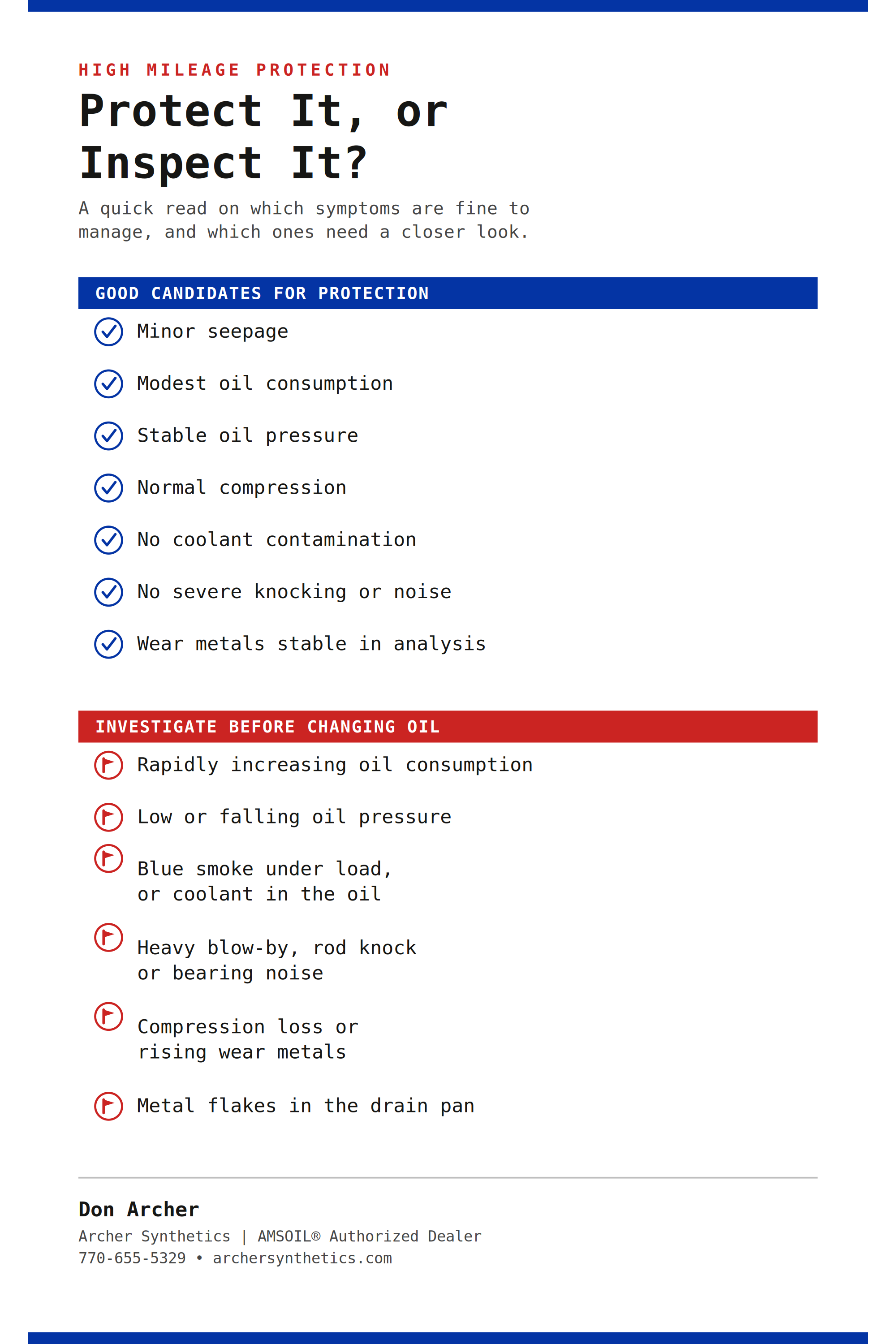
A different oil may help manage symptoms, but it should not be used to hide a failure that needs repair.
3. What is the budget?
The cost of high-mileage synthetic oil is only one part of the calculation. Weigh it against oil and filter cost, downtime, lost production, diagnostic expense, repair cost, replacement cost and expected remaining service life.
If a $35 oil analysis can help you decide whether to keep operating a $10,000 engine, that is a reasonable investment. If a high-mileage oil costs more but reduces consumption and adds useful service life, calculate the actual cost per operating hour—not just the price on the shelf.
That is how I look at maintenance. The goal is not to sell the most expensive bottle. The goal is to protect the equipment when protection still makes financial sense.
If you want help choosing the right option, start with AMSOIL® product recommendations, or contact me with the year, make, model, engine hours or mileage, current viscosity, and symptoms.
If the equipment is valuable or the condition is uncertain, order an oil analysis kit before making a major decision. I’m in the people business, not the oil business. Send me the details, and I’ll help you sort out whether your engine needs better protection, a closer inspection, or a replacement plan.