
The Best Commercial Mower Oil for Landscape Crews
What Actually Holds Up All Season
There’s no shortage of motor oil on the shelf at any farm supply or auto parts store. Most of it will technically work in a commercial mower. That’s not really the question.
The question is whether it holds up — through a Georgia summer, through eight-hour days, through the kind of sustained load that most consumer oil recommendations weren’t designed for.
After working with landscape crews and commercial operators for years, I’ve settled on a pretty clear answer to what commercial mower oil actually needs to do and which AMSOIL® products consistently deliver it.
If you already know you want the product breakdown and nothing else, skip ahead to the recommendations. If you want to understand why the right oil matters for commercial mowing specifically, start here.
Why Commercial Mowing Is Hard on Oil
Consumer oil recommendations are written for passenger cars. A typical car engine runs for 20–40 minutes at a time, sits and cools between trips, and rarely operates at continuous high load. Commercial mowers are the opposite of that in almost every way.
A commercial zero-turn running a full day:
Operates at sustained high RPM for hours without a cool-down cycle
Runs in ambient temperatures that regularly hit 90°F+ in the southeast
Generates engine heat that can push oil temperatures well above 200°F
Accumulates more operating hours in a single season than many cars do in two years
Under those conditions, conventional oil undergoes what’s called thermal breakdown. The base oil molecules literally degrade under sustained heat, viscosity thins, and the oil stops providing the film thickness your engine bearings need. Once that happens, wear accelerates. It doesn’t announce itself. You just end up with an engine life that’s a few hundred hours shorter than it should have been.
This is why commercial mower oil isn’t just a marketing category. The duty cycle genuinely demands more from a lubricant. For a deeper look at what that costs over time, check out our blog, The True Cost of Oil. Itbreaks down the numbers across a real fleet.
What to Look for in a Commercial Mower Oil
Before I get to specific products, here’s the short version of what you’re actually evaluating:
Viscosity Stability at High Temperature
This is the most important spec for commercial mowing. You want an oil that maintains its rated viscosity at operating temperature — not just at the cold pour point listed on the label. A 10W-30 that thins to something closer to a 20 under sustained heat isn’t protecting your engine the way the label implies.
Synthetic base oils maintain viscosity better under heat than conventional oils. It’s not marketing — it’s chemistry. The molecular structure of a synthetic base oil is more uniform and more stable under thermal stress.
Anti-Wear Additive Package
The additive package — specifically the zinc and phosphorus compounds (ZDDP) — is what protects metal surfaces when the oil film is momentarily displaced under load. In a high-cycle commercial engine, that happens constantly. You want an oil with a robust additive package that doesn’t deplete quickly.
Extended Drain Capability
For commercial fleets, extended drain intervals aren’t just a convenience — they’re a meaningful cost and downtime reduction.My blog on fleet maintenance oil covers what that math looks like across a full fleet. The short version: fewer service events means more hours in rotation.
OEM Specification Compliance
Your mower manufacturer specifies an oil viscosity and service classification (typically API SN or SN Plus, or specific OEM standards for brands like Kawasaki, Kohler, Briggs & Stratton, and Honda). Whatever you run needs to meet those specs. All the lubricants I recommend below meet or exceed standard OEM requirements.
AMSOIL® Commercial Mower Oil Recommendations
Here’s how I break it down for the commercial landscape customers I work with. The right product depends on your engine type, your operating conditions, and your service interval goals.
For Most Commercial Walk-Behinds and Zero-Turns: AMSOIL® 10W-30 / SAE 30 Small Engine Oil
This is the workhorse recommendation for the majority of commercial mowing equipment. Most air-cooled engines in commercial walk-behinds and zero-turns — Kawasaki, Kohler, Briggs & Stratton V-twin — call for 10W-30 or SAE 30, and this is where AMSOIL®’s small engine formulation earns its place.
It’s specifically engineered for the high-heat, air-cooled engine environment that liquid-cooled automotive oils aren’t optimized for. The base oil stays in grade through a full operating day, and the additive package is matched to the duty cycle. If you’re only going to make one switch in your fleet, this is it.
For High-Hour Commercial Engines and Fleet Operations: AMSOIL® 10W-40 & 15W-50 Small Engine Oil
If your equipment is logging 500+ hours per season or you’re operating in particularly demanding conditions — steep terrain, continuous heavy cutting, extreme heat — the 10W-40 or 15W-50 small engine oil gives you an extra margin of protection at operating temperature. These heavier viscosity grades are better suited to the heat load of high-hour commercial engines in the Southeast.
Both viscosity grades are full synthetic and maintain shear stability under sustained high-temperature operation, which is exactly the condition a high-hour commercial engine in the Southeast faces all season. The most wear in an engine occurs during the first 30 seconds of operation, before oil pressure builds. In a fleet that’s starting and stopping multiple machines across a day, that adds up.
For Diesel-Powered Commercial Mowers and Out-Front Decks: AMSOIL® Heavy-Duty Synthetic Diesel Oil
A smaller category, but worth covering: some commercial out-front mowers and larger turf equipment run diesel engines. These have different lubrication requirements than gasoline air-cooled engines — specifically around soot management and high-pressure injection system protection.
AMSOIL®’s diesel formulation is what I recommend for any diesel-powered mowing equipment in your fleet. Don’t run a gas engine oil in a diesel engine, even if the viscosity matches.
Don’t Forget the Air Filter and Blade Engagement — But Also: Gear Lube
This one gets missed. Most commercial mowers with deck belt drives or hydrostatic transmissions have a separate gear lube or hydraulic fluid requirement. The engine oil is just one piece of the lubrication picture.
If you’re running a hydrostatic zero-turn, the transmission fluid is doing hard work too — and it’s often changed even less frequently than engine oil. AMSOIL®’s hydraulic and hydrostatic fluid formulations cover this, and getting the right product into the transmission is worth a conversation if you haven’t looked at it recently.
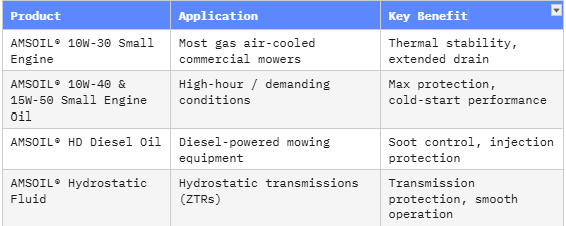
Quick Reference: Commercial Mower Oil by Application
Here’s the short version for your maintenance records or crew handoff:
The Price Question (Let’s Just Address It)
AMSOIL® costs more per quart than the oil at the farm supply. That’s true. Here’s what’s also true:
A commercial zero-turn costs $10,000–$15,000. Some of the larger Scag and Ferris units are pushing $20,000+. The oil that goes in that machine costs less than a tank of fuel. Optimizing on oil cost while running an equipment fleet that size is the wrong place to economize.
The more relevant comparison is total cost of ownership: oil cost plus service labor plus downtime plus engine longevity. When you run that math —
Extended drain intervals mean fewer oil purchases per season, not more
Better protection means fewer premature engine failures, which are expensive
Less maintenance downtime means more billable hours
For most commercial operators I work with, the switch to synthetic either comes out cost-neutral or slightly positive over a full season, and that’s before accounting for engine longevity.
A Note on AMSOIL® Preferred Customer Pricing
If you’re buying oil for multiple machines or ordering in case quantities, AMSOIL® Preferred Customer pricing significantly reduces the per-unit cost— typically 20–25% off retail. For a fleet operation buying oil regularly, that’s worth setting up before your first order. Ask me about it when you reach out.
Getting the Right Oil for Your Equipment
If you’re not sure which product is right for your specific mowers — or if you’re running a mixed fleet with different engine types and want to simplify your oil program — that’s exactly the kind of thing I work through with customers.
Tell me what you’re running and how you’re using it. I’ll give you a straight answer on the right products and the right service intervals for your operation. No upsell, no runaround.
Shop commercial mower oil at archersynthetics.com | Or reach out directly: Don Archer | 770-655-5329
Orders ship directly through AMSOIL® — no middleman, no warehouse delays.
FAQ: Commercial Mower Oil
What weight oil is best for a commercial zero-turn mower?
Most commercial zero-turns with air-cooled engines specify 10W-30 or SAE 30. Check your engine manufacturer’s recommendation first — Kawasaki, Kohler, Briggs & Stratton, and Honda each have their own specs. AMSOIL® 10W-30 Small Engine Oil meets or exceeds the requirements for the most common commercial engine brands.
Can I use regular motor oil in a commercial mower?
Technically, yes, if it meets the viscosity and service rating. But consumer automotive oil is formulated for liquid-cooled engines with different thermal profiles than commercial air-cooled mowers. A synthetic small engine oil specifically formulated for air-cooled applications will outperform a generic automotive oil under sustained commercial load.
How often should I change oil in a commercial mower?
OEM recommendations typically land around every 50–75 hours for conventional oil. With a quality synthetic like AMSOIL®, many commercial operators safely extend that interval up to 200 hours or 1 year — confirmed with oil analysis. Fewer oil changes mean less downtime and lower maintenance costs per season.
Does synthetic oil void a commercial mower warranty?
No, as long as the oil meets the OEM’s specified viscosity and service classification. The Magnuson-Moss Warranty Act protects your right to use third-party lubricants. AMSOIL® products are Warranty Secure™, meaning they’re designed to meet or exceed OEM specifications.
What’s the difference between small engine oil and regular motor oil?
Small engine oils — specifically those formulated for air-cooled commercial engines — are designed to handle higher sustained operating temperatures and different additive requirements than liquid-cooled automotive engines. For commercial mowing equipment, using a purpose-built small engine oil rather than a repurposed automotive product is the right call.
AMSOIL® is a registered trademark of AMSOIL INC. Warranty Secure™ is a trademark of AMSOIL INC. All AMSOIL products available through Archer Synthetics, Authorized AMSOIL Dealer (ZO# 515216) at archersynthetics.com.