
Landscape Equipment Oil: The Complete Guide for Commercial Crews
Ask a landscape contractor what oil they run, and you’ll usually get one of two answers: the brand they’ve always bought, or a shrug followed by “whatever’s on the shelf.”
Neither of those is a strategy. And for a business running $200,000 worth of equipment through a Georgia summer, it’s worth having an actual strategy.
The challenge with landscape equipment, specifically, is that the lubrication picture is more complicated than most people realize. A typical landscape operation isn’t running one type of engine — it’s running five or six. Each one has different requirements, different failure modes, and different consequences when the wrong product goes in or the right product runs too long.
This guide covers it all: 4-stroke mowers, 2-stroke handheld equipment, hydraulic systems, diesel service trucks, and the specialty applications that tend to get overlooked until something breaks. I’ll also give you a simple reference table at the end that you can use as a starting point for your own fleet.
I’ve been working with commercial landscape operators as an AMSOIL® dealer for years. This is how I’d walk through your fleet if we were sitting down together.
The Landscape Fleet Problem Nobody Talks About
Here’s the thing about running a landscape business: you’re managing a fundamentally complex lubrication picture, and most of the industry treats it like it’s simple.
Walk through what a mid-size landscape operation actually runs:
Commercial zero-turns and walk-behinds — air-cooled 4-stroke gasoline engines
String trimmers, edgers, and brush cutters — 2-stroke gasoline engines
Chainsaws — 2-stroke, often a different oil requirement than trimmers
Backpack and handheld blowers — 2-stroke gasoline engines
Skid steers or compact track loaders — diesel engine plus hydraulic system
Service trucks — diesel or gas, often running hard between job sites
Trailers with hydraulic lifts or tilt beds — hydraulic fluid
Compact tractors (for larger operations) — diesel engine, tractor hydraulic fluid, PTO
That’s potentially seven or eight different lubrication requirements in a single fleet. Most operators are buying oil from three different places, keeping partial containers of four different products in the shop, and hoping the right stuff is on hand when they need it.
The goal of this guide — and what I do with commercial customers — is to simplify that. Get the right product into every machine, set realistic service intervals, and turn a chaotic maintenance situation into a system.
If you want to understand what the downtime and cost picture looks like across a fleet before diving into specific products, our blog on fleet maintenance oil strategy covers that ground. For the specific mower side of the equation, our Commercial Mower Oil Guide goes deeper on engine selection for zero-turns and walk-behinds.
4-Stroke Equipment: Mowers, Compact Tractors, and Larger Engines
The 4-stroke gasoline engines in your commercial mowers are the workhorses of a landscape fleet, and they’re also where most of the lubrication money gets spent. Get this right, and you’re protecting your most significant equipment investment.
What Makes Commercial Mowing Hard on Engine Oil
Consumer oil recommendations are engineered around automotive duty cycles — 20-minute trips, cool-down periods between uses, and liquid cooling to manage operating temperatures. Commercial air-cooled mowing engines experience the opposite of all of that.
A commercial zero-turn running a full day in July:
Operates at sustained high RPM for hours without stopping
Relies entirely on air cooling — no liquid cooling system to buffer heat
Runs engine oil temperatures that can exceed 250°F under sustained load
Accumulates 600+ operating hours in a single season for busy crews
At those temperatures, conventional oil undergoes thermal breakdown. The base oil molecules degrade, viscosity thins, oxidation occurs, and the oil stops providing the protective film your engine bearings and cam lobes need. The wear doesn’t announce itself — it just quietly shortens the life of a $10,000–$15,000 piece of equipment.
Premium Synthetic oil holds viscosity under heat in a way conventional oil simply doesn’t. It’s not a marginal improvement — at 250°F, a quality full synthetic and a conventional oil are performing very differently.
What to Run in Your Commercial Mowers
Most commercial air-cooled engines — Kawasaki FX and FR series, Kohler Command Pro, Briggs & Stratton Commercial Series — specify 10W-30 or SAE 30. AMSOIL®’s small engine synthetic oil line is specifically engineered for these applications, not repurposed from an automotive formulation.
For high-hour operations or particularly demanding conditions (steep terrain, continuous heavy cutting, extreme heat), AMSOIL’s purpose-built small engine synthetic oils give you an additional margin of protection at high operating temperatures and better cold-start coverage on early mornings.
Engine oil is just part of the mower's lubrication picture. The Commercial Mower Oil Guide covers hydrostatic transmission fluid and deck system lubrication as well — worth reading alongside this if your fleet is primarily mower-heavy.
Compact Tractors and Larger 4-Stroke Equipment
If your operation runs compact tractors — for installation work, site prep, or larger property maintenance — the lubrication picture gets more complex. Tractors have separate requirements for:
Engine oil (often diesel — different requirements than gasoline engines)
Transmission / hydraulic fluid — frequently a combined system in compact tractors
Front axle and differential lubricants
PTO gearbox, if equipped
The biggest mistake I see with tractors in landscape fleets is running a single “universal tractor fluid” in everything because it’s convenient. That works until it doesn’t. AMSOIL®’s tractor hydraulic fluid and gear lubricant formulations are worth a specific conversation if you’re running compact equipment regularly.
2-Stroke Equipment: Trimmers, Blowers, Chainsaws
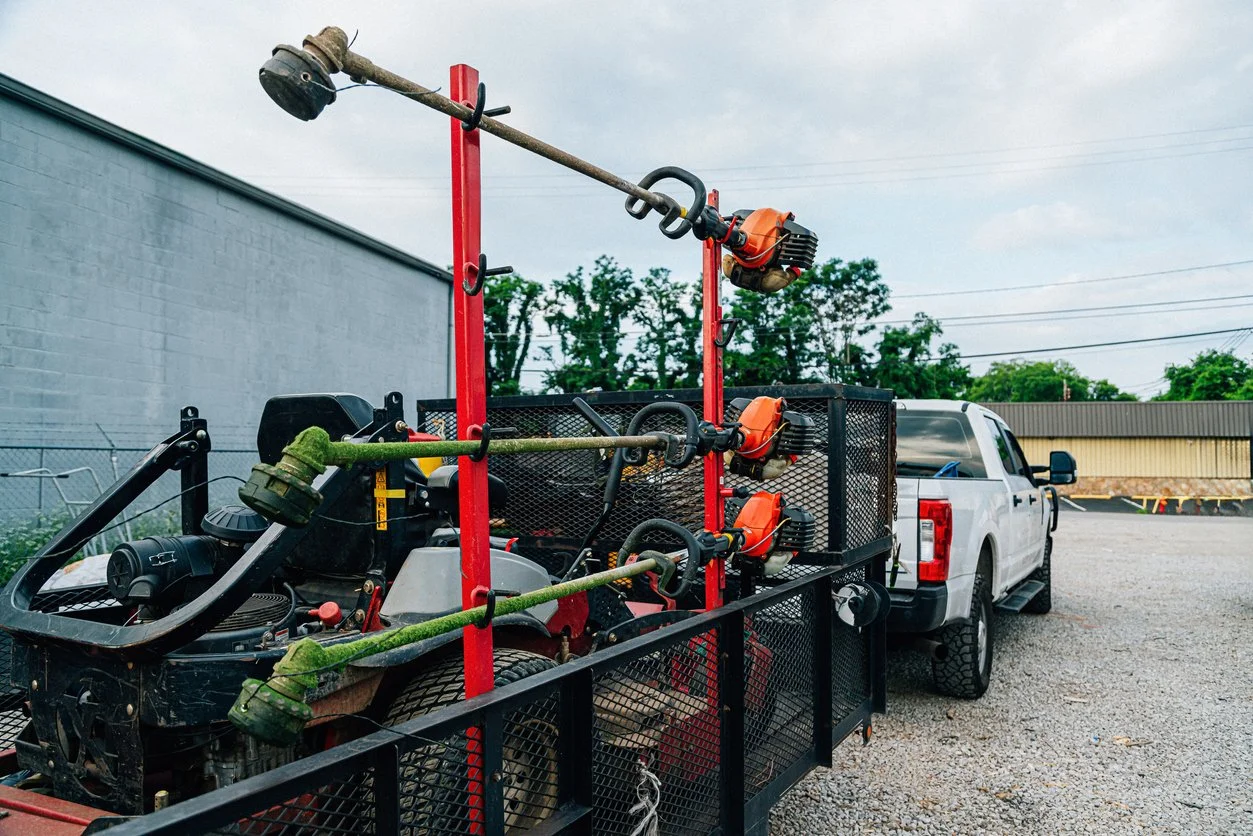
This is the category where I see the most mistakes and the most preventable equipment failures. 2-stroke oil is not just lubrication. In a 2-stroke engine, the oil is mixed with fuel and burns with it. That means it’s also responsible for combustion cleanliness, carbon deposit control, and smoke emissions. The quality of the oil directly affects how the engine runs and how long it lasts.
Cheap 2-stroke oil — and there’s a lot of it on the market — leaves carbon deposits on the piston, exhaust port and spark arrestors. Those deposits build up over a season. They reduce power, increase fuel consumption, and eventually cause the kind of mechanical failure that sends you shopping for a new trimmer or blower in the middle of August.
Pre-Mix vs. Separate Oil Injection Systems
Most handheld landscape equipment uses a pre-mix system — you mix oil into the fuel at a specific ratio (typically 50:1 for modern equipment, though some older or higher-performance equipment runs 40:1 or 32:1). Always check your equipment manual for the correct ratio. Running lean on oil to save money is a false economy.
What to Run: AMSOIL SABER 2-stroke oil
For commercial landscape crews running handheld equipment hard, AMSOIL® SABER is the product I recommend. It’s purpose-built for professional handheld 2-stroke equipment — specifically formulated to eliminate the problems that plague this category: hard starting, rough running, power loss, and shortened service life. AMSOIL tested SABER® Professional at a 100:1 mix ratio against competing oils at 50:1, and it outperformed the competition in every area, including carbon deposit control. Even using half as much oil, it did a better job keeping engines clean.
The practical benefits for commercial use:
Significantly reduced carbon deposit buildup, so spark arrestors and exhaust ports stay cleaner
Better power retention over the life of the equipment
Works at 32:1 up to 100:1 ratios, depending on application — the 100:1 mix is optimal and particularly useful for operators who want to simplify their pre-mix program and reduce costs by 50% or more
Compatible with all 2-stroke pre-mix equipment
The 100:1 capability is worth noting specifically for commercial operations. If you’re pre-mixing fuel for a fleet of handheld equipment, running everything at 100:1 with SABER simplifies your fuel program without sacrificing protection. One mix ratio, one product, every handheld in the fleet.
A Note on Ethanol
If you’re running pre-mixed fuel in your handheld equipment and storing it for any length of time, ethanol is a real problem. E10 fuel (10% ethanol, which is standard at most pumps) absorbs moisture, degrades over as little as 30 days, and can damage carburetors and fuel lines in small engines.
For commercial operations, mixing your own with ethanol-free premium is worth the extra cost. It’s not an oil question exactly, but it’s the kind of thing I mention to every commercial customer because I’ve seen it cause a lot of expensive problems. For pre-mixed fuel that’s going to sit, AMSOIL QUICKSHOT® and AMSOIL Gasoline Stabilizer are both worth adding to the program — they prevent the fuel degradation that causes most of the hard-starting and carburetor issues I see every spring.
Hydraulic Systems: The Most Overlooked Part of the Fleet
If you’re running skid steers, compact track loaders, hydraulic trailer lifts, or any other equipment with hydraulic systems, you have a lubrication requirement that operates completely differently from your engine oil — and one that tends to get far less attention than it deserves.
Hydraulic systems fail in two primary ways: contamination and thermal degradation. Both are manageable with the right fluid and the right service intervals. Both are expensive when they’re ignored.
Contamination: The Silent Killer of Hydraulic Systems
Hydraulic fluid is a closed system, but it’s not perfectly sealed. On a construction or landscape job site, airborne dust, moisture, and debris find their way in over time — through breather caps, cylinder rod seals, and service points. Once contamination is in the system, it circulates through every valve, pump, and cylinder.
A high-quality hydraulic fluid with good contamination resistance buys you time. More importantly, following a consistent fluid change interval and using a hydraulic system with the correct filtration prevents the kind of pump and valve damage that turns a $300 fluid change into a $3,000 repair.
What to Run: AMSOIL® Synthetic Hydraulic Oil
AMSOIL®’s synthetic hydraulic oil formulations are designed for the thermal stability and contamination resistance that commercial equipment demands. For landscape fleet applications, the ISO 46 viscosity is appropriate for most equipment operating in warm conditions (ISO 32 and 68 are also available) — confirm your equipment manufacturer’s hydraulic fluid specification before switching.
Key advantages for commercial use:
Thermal stability at the operating temperatures hydraulic systems reach under sustained load
Better oxidation resistance, which extends fluid service life
Compatible with most hydraulic system seals and components
Extended drain intervals versus conventional hydraulic fluid, reducing service downtime
If you’re running a skid steer in your landscape fleet, also pay attention to the final drive and chain case lubrication requirements — these are separate from the hydraulic system and have their own specific products. AMSOIL® Severe Gear® synthetic gear lube protects the final drive, and getting this right is important for machines working hard in abrasive outdoor conditions.
Service Trucks: Diesel Engine Oil for Fleet Vehicles
The service trucks in your landscape fleet are doing something different from your mowing equipment — they’re running stop-and-go between job sites, sometimes towing heavy equipment trailers. In many operations, they’re also the most-used vehicles in the business. The engine oil requirements are different from those of your air-cooled mowing equipment, and they deserve the same level of attention.
Why Diesel Fleet Trucks Have Specific Oil Needs
Diesel engines produce significantly more soot than gasoline engines — it’s a byproduct of how diesel combustion works. That soot ends up in the engine oil, where it needs to be held in suspension until the next oil change rather than depositing on engine surfaces. A diesel engine oil’s ability to manage soot load is a primary spec, and it’s one of the key differences between diesel-rated oils and gasoline engine oils.
For fleet trucks towing equipment trailers — which is most landscape operations — you also have sustained high-load operation that accelerates thermal breakdown in lower-quality oils. This is the same principle as the mowing equipment: sustained load and heat are harder on oil than the duty cycles most consumer products are rated for.
What to Run: AMSOIL® Heavy-Duty Synthetic Diesel Oil and Max-Duty Signature Series
For landscape fleet service trucks, AMSOIL®’s heavy-duty diesel oil is the recommendation. Available in 5W-40 and 15W-40, it’s formulated for the soot management, oxidation resistance, and extended drain interval capability that commercial fleet trucks need.
The extended drain interval capability is particularly valuable for fleet vehicles. If you’re currently changing truck oil every 5,000–7,500 miles on a conventional oil schedule, moving to AMSOIL® synthetic with an oil analysis program can extend that significantly — reducing service frequency and keeping your trucks on the road rather than in the shop.
The math on what that looks like across a fleet of trucks is covered in detail in our blog on Fleet Maintenance Oil Strategy — the numbers are compelling once you run them.
Building a Lubrication System for Your Landscape Fleet
Products are straightforward. What’s harder — and more valuable — is building a maintenance system your crew can actually follow. The best oil in the world doesn’t help if service intervals slip because nobody has a clear record of when the last service was.
When I work with a commercial landscape customer, here’s the framework I use:
Step 1: Map the Fleet
Write down every piece of powered equipment in your operation, what engine type it runs, and what the manufacturer specifies for oil type and viscosity. This sounds obvious, but most operations have never done it in one place. The list usually has a few surprises. AMSOIL MyGarage offers many preventive maintenance benefits, and it’s FREE for customers to use.
Step 2: Assign the Right Product to Each Machine
This is where I can help directly. Once I know what you’re running, I can tell you exactly which AMSOIL® product goes in each piece of equipment. The goal is to consolidate where possible — sometimes you can run one product across multiple machines, which simplifies inventory and ordering.
Step 3: Set Realistic Service Intervals
OEM intervals are a starting point, not a ceiling. With synthetic oil and an oil analysis program, most commercial equipment can safely extend service intervals — which means fewer times each machine is pulled out of rotation. For a busy landscape crew, that matters.
Oil analysis is the tool that makes extended intervals confident rather than risky. A $30-35 oil analysis on your highest-hour machines tells you exactly what’s happening inside the engine and whether the oil is still protecting. I recommend it for any machine logging 400+ hours per season.
Step 4: Build the Record
Simple maintenance log, one row per machine, tracking last service date and hours. Doesn’t need to be elaborate. A spreadsheet or even a clipboard in the shop works. The point is that anyone on the crew can check what’s been done and when — and you’re not relying on memory.
Don’t want to build this from scratch?
Reach out, and I’ll walk through your fleet with you — what you’re running, which products go where, and which service intervals make sense for your operation. That’s the conversation I have with every new commercial customer. It’s free, it takes about 20 minutes, and it usually saves real money. Shoot me an email at archersynthetics@gmail.com or give me a call at 770-655-5329, and we’ll get you set up.
Seasonal Considerations for Georgia Landscape Operations
Geography matters for lubrication strategy, and Georgia’s climate creates specific conditions worth addressing.
Summer: The High-Risk Season
Peak season in the Southeast means sustained heat on top of sustained operating load. Ambient temperatures regularly hitting 90°F+ mean your equipment is starting from a higher baseline — engine oil temperatures can push well above 250°F in air-cooled equipment during a full operating day in July.
This is when the quality gap between conventional and synthetic oil is most visible. If you’re going to make one change to your lubrication program, do it before summer. The protection differential is largest when the conditions are hardest.
Start of Season: The Right Time for Fresh Oil
If your equipment sits over winter — even partially — the start of the season is the right time to change oil regardless of where you are in the service interval. Oil that’s been sitting accumulates moisture and acid byproducts over time. Starting the season with fresh synthetic gives you full protection from the first hour of operation.
This is also a good time to check your 2-stroke premix fuel supply. Fuel stored over winter degrades, and old pre-mix is a common cause of hard-starting and carburetor issues in the spring. Drain it and start fresh.
End of Season: Storage Prep
For equipment going into storage over winter, changing the oil before storage (rather than in the spring) is the better practice. Used oil contains combustion byproducts and acids that continue to corrode engine internals during storage. Fresh synthetic going into storage means the engine is protected through the off-season.
For 2-stroke handheld equipment, run the fuel system dry before storage or use a fuel stabilizer. Fuel sitting in carburetors over winter is a reliable source of spring headaches.
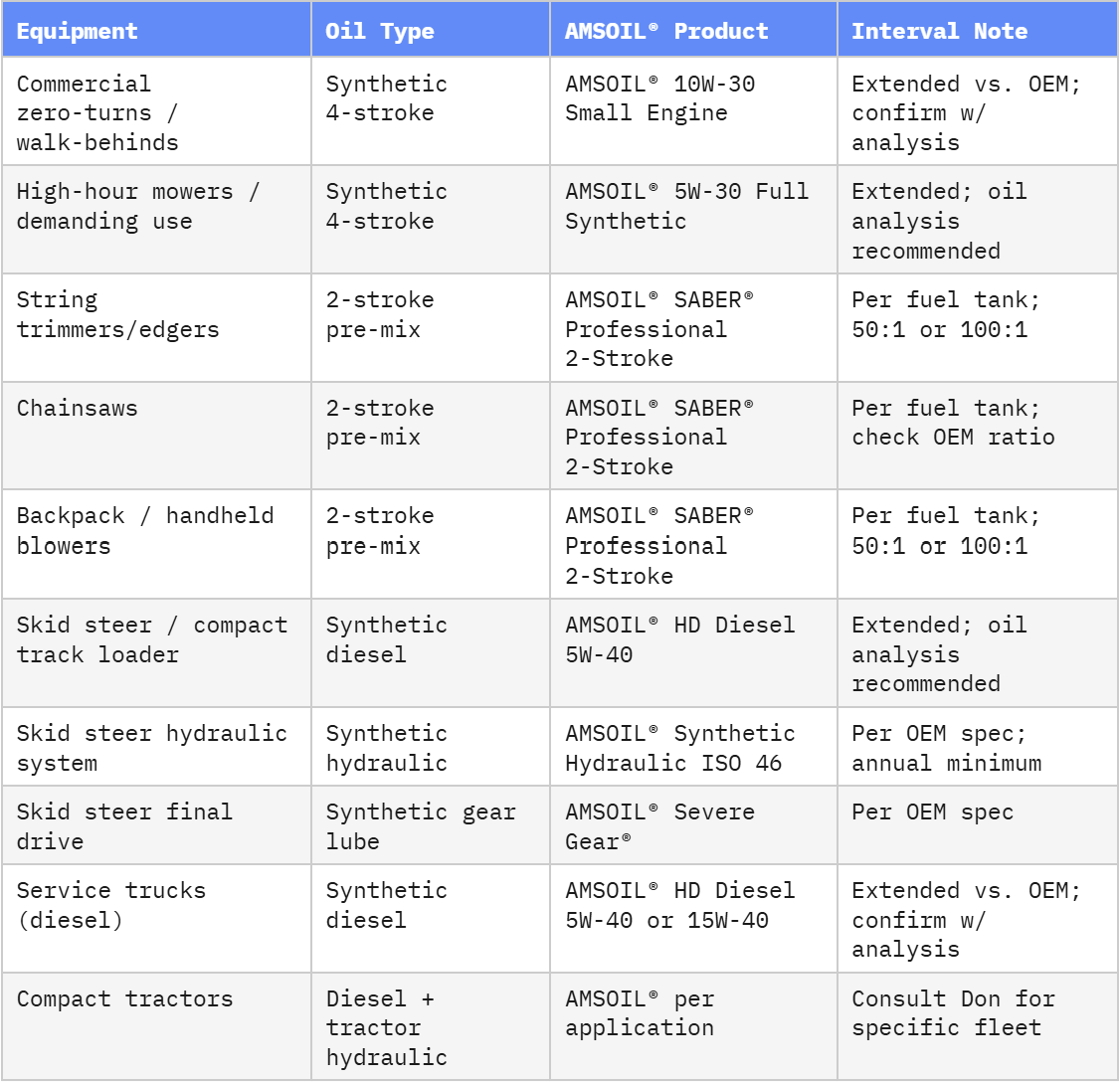
Quick Reference: Landscape Fleet Lubrication Guide
Here’s a starting point for your fleet maintenance records. Specific product recommendations may vary based on your equipment manufacturer’s specifications — reach out if you want this mapped to your exact fleet.
One Conversation, One Trusted Source
The point of this guide is to show you that landscape equipment lubrication isn’t complicated — it just requires paying attention to the right things for each machine in your fleet.
What I do for commercial landscape customers is take this off your plate. Tell me what you’re running — every piece of powered equipment in your operation — and I’ll send you the exact products for each machine, the service intervals that make sense for your usage, and a simple maintenance log to track it all.
No guesswork. No running three different brands from three different stores. One call, one source, one program that actually matches how your fleet operates.
That’s what I mean when I say I’m in the people business, not the oil business.
Reach out: Don Archer | 770-655-5329 | archersynthetics@gmail.com
Orders ship directly through AMSOIL® — no warehouse delays, drop-shipped to your door.
FAQ: Landscape Equipment Oil
What oil should I use in my commercial zero-turn mower?
Most commercial zero-turns with air-cooled engines specify 10W-30 or SAE 30. AMSOIL®’s small engine synthetic oil is specifically formulated for air-cooled commercial mowing applications — not repurposed from an automotive formula. Check your engine manufacturer’s spec first (Kawasaki, Kohler, Briggs & Stratton each have their own), then confirm the product meets those requirements.
Can I use the same oil in my trimmer and my mower?
No. Your mower runs a 4-stroke engine that uses engine oil in a separate reservoir. Your trimmer runs a 2-stroke engine where oil is mixed directly into the fuel. These are completely different products. Running 4-stroke oil in a 2-stroke engine (or vice versa) will damage the equipment.
How often should I change the oil on my landscape equipment?
OEM recommendations typically range from 100–150 hours for commercial mowers using conventional oil. With AMSOIL® synthetic, many operators safely extend that interval, confirmed with oil analysis. For 2-stroke equipment, the oil mixes with fuel and burns — there’s no oil change, just consistent use of quality pre-mix. For hydraulic systems and transmissions, follow OEM guidance and change annually at a minimum.
Is synthetic oil worth it for landscape equipment?
Yes — especially for commercial operations. The thermal conditions of commercial mowing are more demanding than consumer oil recommendations are designed for. Synthetic oil maintains viscosity at high temperatures, extends drain intervals, and protects equipment that represents a significant capital investment. Our blog on the true cost of oil covers the financial case in detail if you want to run the numbers.
What’s the best 2-stroke oil for commercial trimmers?
AMSOIL® DOMINATOR® is what I recommend for commercial crews. It reduces carbon deposit buildup, maintains power output over the life of the equipment, and works at 100:1 mix ratios for operators who want to simplify their pre-mix program. For a crew running multiple handheld tools, one product at one mix ratio is a real operational simplification.
Do I need different hydraulic fluid for my skid steer?
Yes. Hydraulic systems have different lubrication requirements than engine oil applications, and using the wrong product can cause seal damage or pump failure. AMSOIL®’s synthetic hydraulic fluid is the right product for skid steer hydraulic systems — but also check the separate requirements for your final drive and chain case, which are different again.
AMSOIL® and DOMINATOR® are registered trademarks of AMSOIL INC. Severe Gear® is a registered trademark of AMSOIL INC. Warranty Secure™ is a trademark of AMSOIL INC. All AMSOIL® products available through Archer Synthetics, Authorized AMSOIL® Dealer (ZO# 515216) at archersynthetics.com.